
Weeds get a bad rap. They're pulled, sprayed, and cursed at, treated as something to overcome rather than something to get to know. Many of the plants we work hardest to get rid of are among the most nutritious, medicinal, and generous plants on earth. This series is a case for looking twice. The weed in your yard might just know something you don't.
For a long time, I’d been hiding. Not on purpose, exactly. My writing sat unfinished in folders because it wasn’t perfect yet, and my herbal studies were something I did quietly, on the side. I had also spent the last year or so overextended and teetering on the edge of burnout, partly because I was pouring so much energy into maintaining an old version of myself, one I’d already started to outgrow. When it all finally caught up with me, I turned inward to recover. At the time, this was what I needed. But somewhere along the way, staying tucked away started to feel safer than being seen.
Queen Anne’s lace has never had that problem.
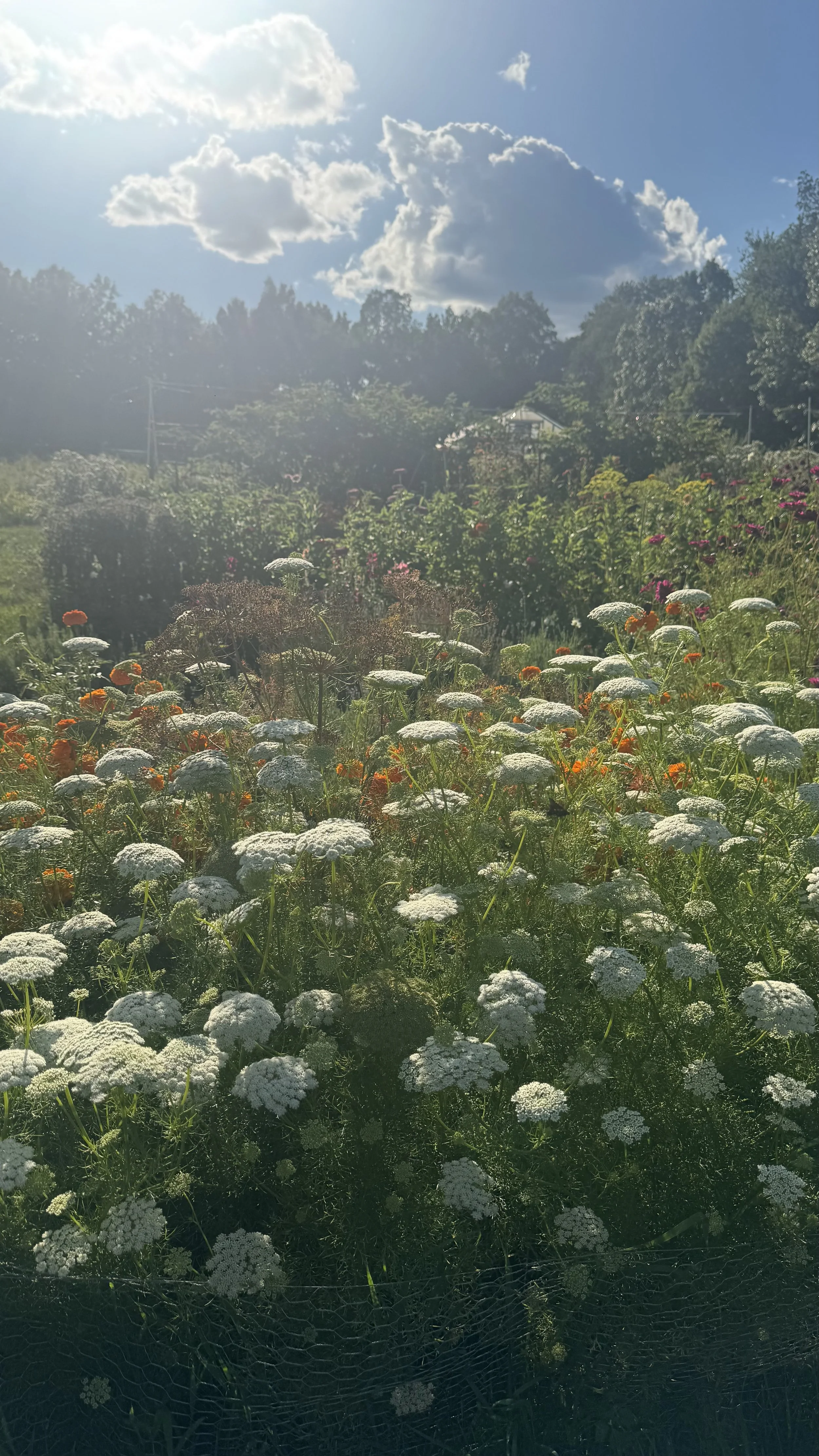
Every year, as the heat of summer settles in, she appears in hordes along highways and coastlines, in sidewalk cracks and backyards across the Northeast, where she proudly opens her dainty white flowers. She doesn’t wait for a good spot or an invitation. She just shows up.
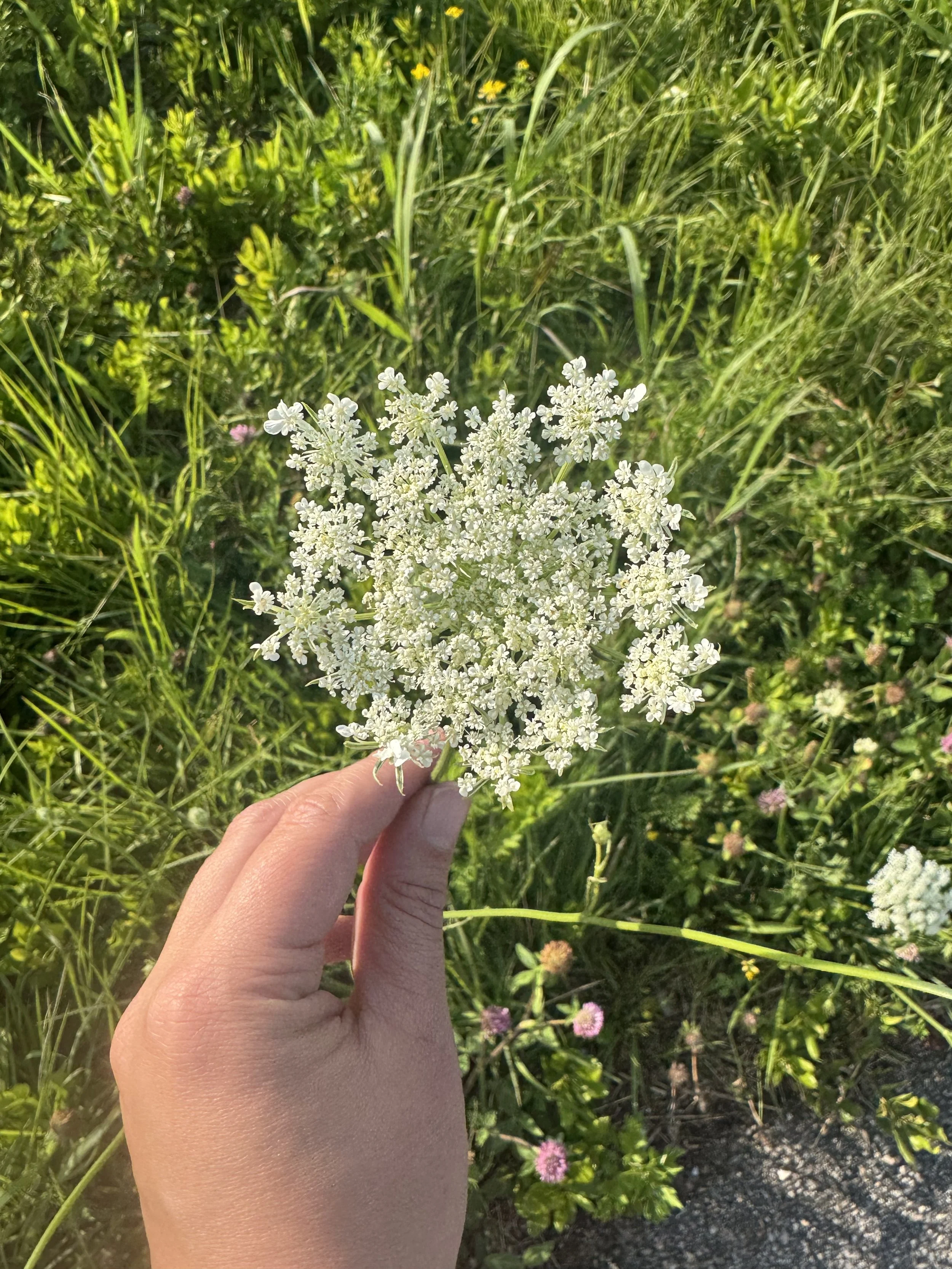
Queen Anne’s lace (Daucus carota), also known as wild carrot, is the ancestor of our cultivated carrot. A native of Europe, she is a biennial that grows to about three feet tall, with feathery, finely divided leaves and flat clusters of tiny white flowers called umbels, each three to four inches across. Crush the leaves or root and you’ll smell it: carrot. She loves roadsides, meadows, and neglected pastures, and she spreads by seed alone, which is why gardeners are quick to pull her before she goes to seed.
As she goes to seed, the open, lacy umbel curls inward into a tight, cupped shape, earning her the name bird’s nest. She shelters what she’s growing until it’s ready. Then, without hesitation, she opens and lets it go.
Look closely at the center of some flowers and you might find a single tiny floret, reddish purple to almost black. According to legend, Queen Anne pricked her finger while sewing her lace, and a drop of blood fell onto the flower (though only about a quarter of the plants actually have this signature.) Another telling ties her name to St. Anne, the mother of Mary, and to the plant’s long history as a women’s remedy.
Pricking one’s finger is an ancient motif in fairytales and European folklore. The character who pricks their finger is suddenly pushed, unprepared, into the next chapter of life. It marks an awakening, and often a new awareness of the body and its vulnerability. The old herbalists saw this side of her too. Nicholas Culpeper placed wild carrot under both Mercury, for breaking up stagnant blood and removing gas, and Venus, for her strong connection to procreation.
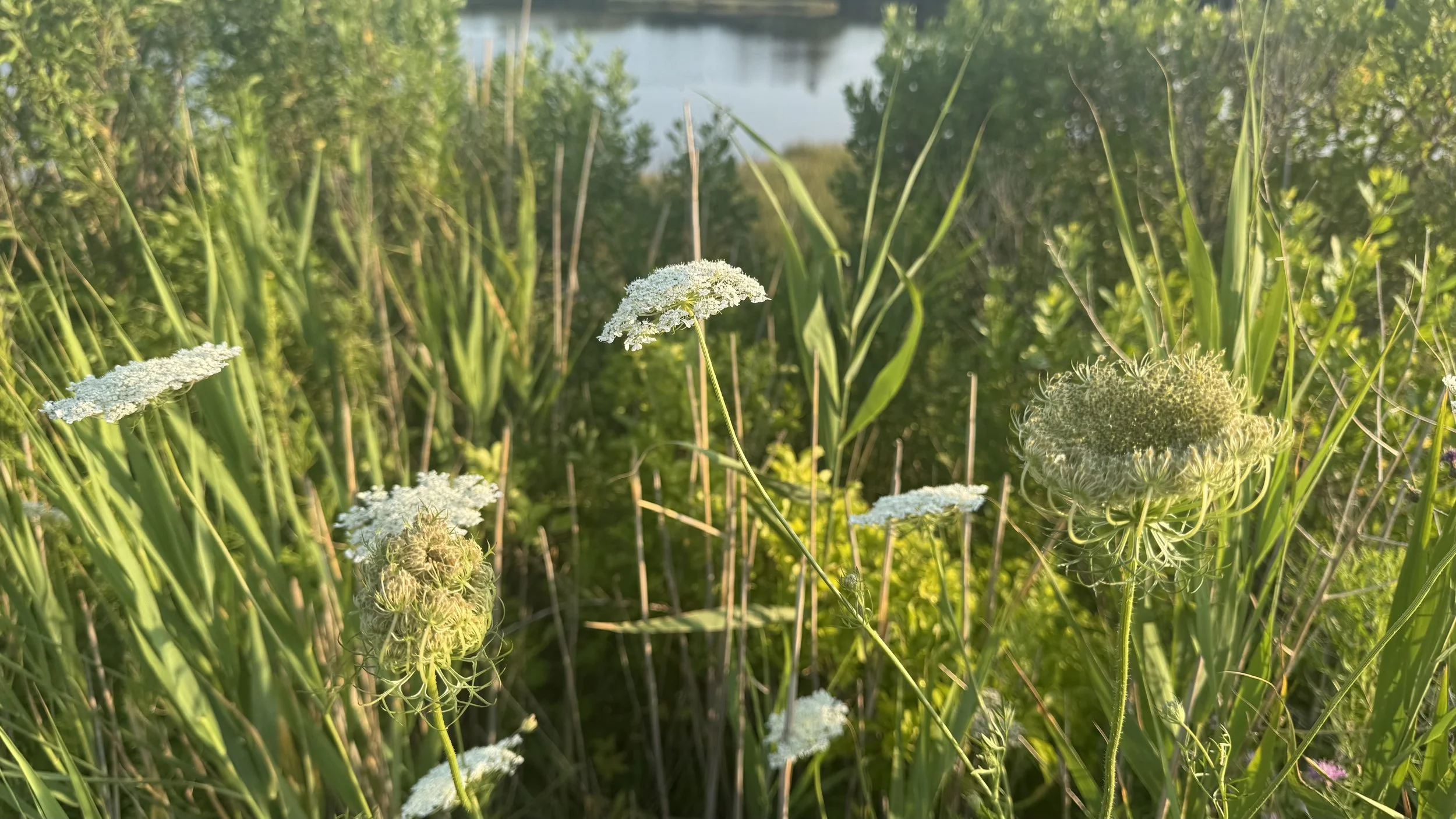
Before we continue, it’s worth emphasizing that the Queen has a few doppelgangers, and some of them are poisonous. One is the renowned first aid herb yarrow. Another is the not so medicinal poison hemlock, the plant that killed Socrates. You can tell them apart by the stems, the leaf structure, and how the flowers are arranged. Queen Anne’s stem is covered in fine hairs, while poison hemlock’s is smooth and often blotched with purple, and it smells musty rather than like carrot. Remember, the Queen has hairy legs, and she isn’t shy about showing them. Never harvest or consume a plant unless you are 100% confident you have identified it correctly.
Medicinally, Queen Anne’s lace is best known as a hormone normalizer. She is sweet, salty, pungent, and bitter, with a slightly warming energy. Herbalists have traditionally used Queen Anne to support the endocrine system, including the thyroid, pituitary, pancreas, and adrenals. That is exactly why I first reached for her, when months of stress had thrown my hormones out of whack. She is also traditionally used for blood sugar balance, and she suits people who hold water or feel puffy under the skin.
She is a gentle diuretic with a strong affinity for the urinary tract. She promotes the excretion of uric acid, making her useful for gout, and has long been used to help prevent and flush out urinary stones and gravel. Herbalist Matthew Wood described her as helping to “thread the urine through the kidneys,” a fitting image for a plant named after a seamstress. She also gets peripheral lymphatic circulation moving, helping clear excess fluid from the tissues.
The seeds are rich in volatile oils that soothe digestion and ease gas and colic. They also act on the uterus, moving stagnant blood, and regulating the cycle, lightening heavy flow, and addressing excess growth of the uterine lining. The roots, like their cultivated cousin, are full of vitamins and minerals and gentle on an irritated stomach.
Her seeds have a long folk history use as a contraceptive (though she’s an ally here, not a guarantee). Because the seeds stimulate the uterus, avoid Queen Anne’s lace during pregnancy or while trying to conceive. If you take medication for your thyroid or blood sugar, or blood thinners, check with your provider first. If you’re dealing with endometriosis or very heavy bleeding, work with a practitioner rather than treating it on your own.
These days she is part of my daily rhythm. Each summer I gather her flowering tops and, later, her seeds, and turn them into a tincture that is part of my regular rotation. A tincture made with higher proof alcohol extracts her volatile oils best, and only a few drops are needed. She finds her way into my tea blends, too. She can also be made into an infusion (about an ounce of tops or seeds per quart of water), a vinegar, a glycerite, or a rinse for skin, hair, or in the bath.
I also work with her as a flower essence, connecting with the plant on a subtler, more energetic level. She is associated with the Moon, with intuition and inner sight, and with the kind of knowing that lives below thought. She opens the heart to sensuality and creativity, and invites desire and spirit into the same room. She offers a sense of safety and belonging, the feeling that it’s okay to soften and open. She is the divine feminine in plant form: soft, and still powerful. To me, she is the essence of letting yourself be seen.
My season in the nest did what it needed to do. And now I’m practicing what the Queen does every summer: showing up in plain sight, a little wild, with hairy legs and all.
