
Notes from the Farm: Part Two
This is the second installment in a series following one student's journey through the Level I Herbal Apprenticeship at the Boston School of Herbal Studies. Each month, we'll share a dispatch from the farm: what we're learning, what's growing, and what the plants have to say. Follow along. To learn more about the apprenticeship, visit bostonherbalstudies.com/education.
Session Two arrived on a Taurus New Moon. The farm was in full alignment.
Taurus is the fixed, grounded intelligence that knows when to stay still in order to absorb nutrients and consolidate growth. A new moon is a time for planting seeds, for setting intentions, for beginning things that will take time to root. A fitting backdrop for what turned out to be a weekend about exactly that: the slow, nourishing work of putting down roots. In knowledge, in practice, and in each other.
The fields were lush and fully awake. The air smelled like warm earth and green things. And somewhere between the nettle patch and the kitchen, something shifted in this group of apprentices. We stopped being people who were learning about plants and started becoming people who feed each other with them.
We'll get to the pesto in a moment. First, we foraged.
We harvested nettles and garlic mustard. Beckett, who has been cooking with farm herbs for years, set up in the outdoor kitchen. Together we made a nettle soup, chopping vegetables and stirring our intentions into the pot. Did you know that letting garlic, onion, and other alliums rest for ten minutes after chopping allows the chemical reactions that maximize allicin to fully develop? Allicin is the compound behind garlic's immune-boosting and anti-inflammatory properties. Beckett offered that kind of wisdom at every step; the kind that lives between the lines of recipes.
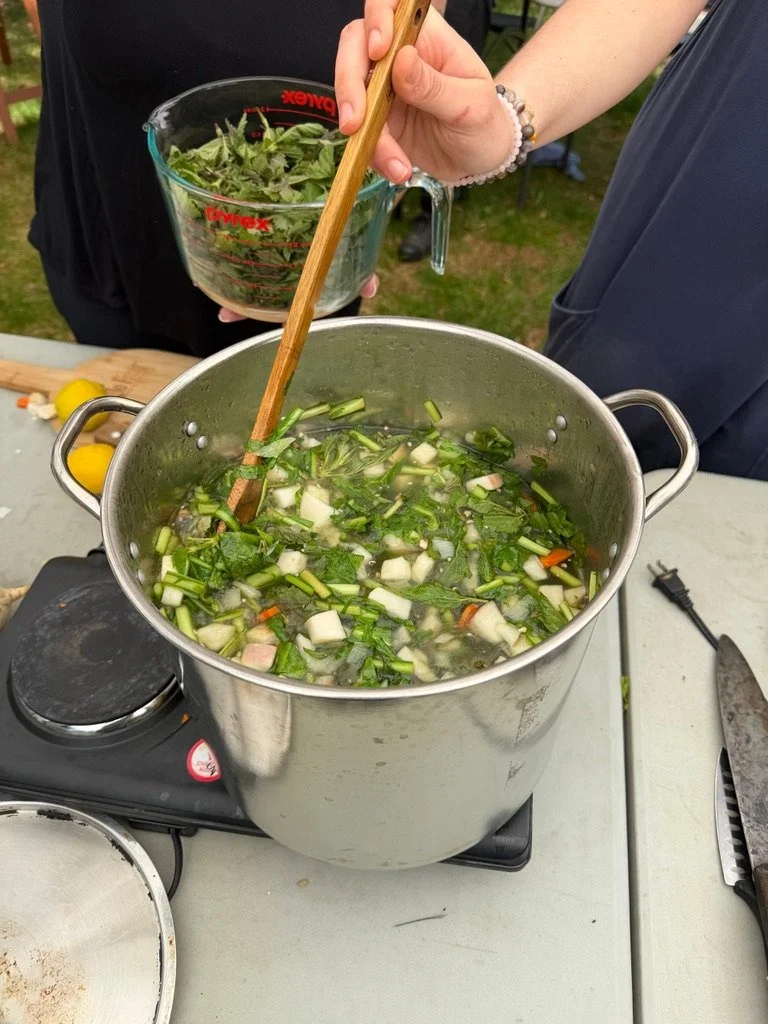
The pesto, it turns out, is something none of us had truly experienced before, because we had never had it made from something we pulled out of the ground an hour prior.
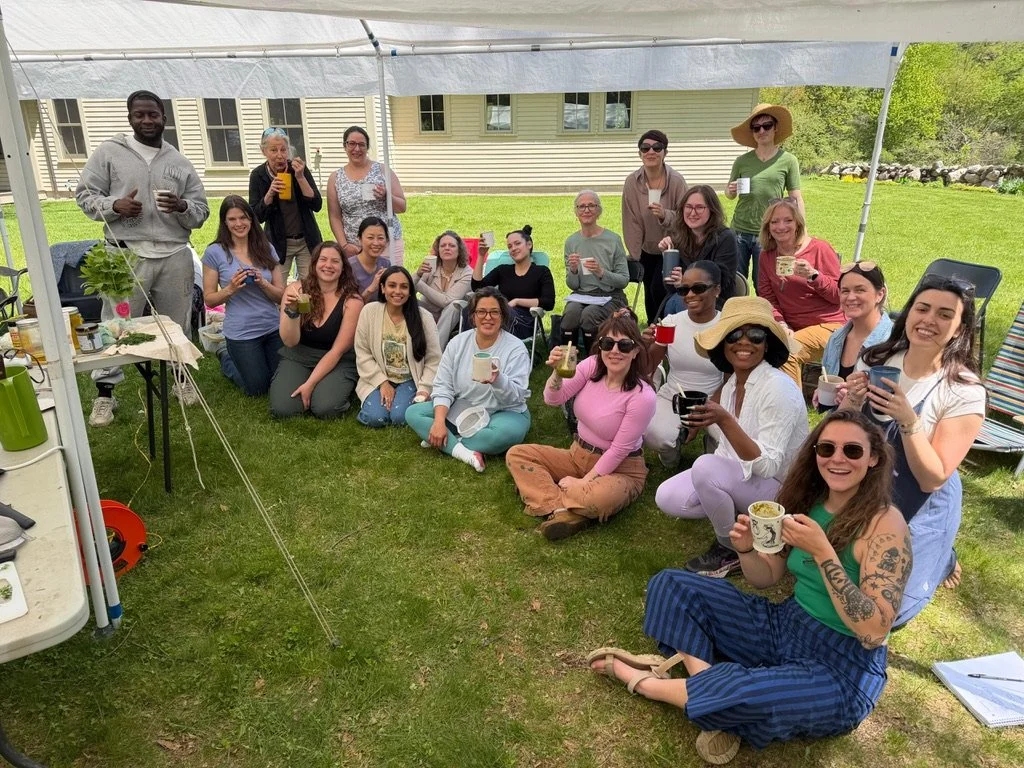
There was a moment when the group gathered around the table with their mugs and bowls, all of it tasting exactly like the green all around us, and it was the kind of moment that is hard to describe and easy to recognize. This is why people do this. This is what the apprenticeship is building toward: not just a knowledge of plants, but a relationship with them. One that runs through the hands and the body and the kitchen and the table.
Lunchtime on the farm has become the part of each session I look forward to most. Not only because it is a chance to pause and absorb what the morning brought, but because of what happens in those in-between moments: conversations that deepen, friendships forming over shared interests, plans made for what to forage or make before the next session. The community is growing the way plants do: quietly, steadily, putting down roots before anyone quite notices.
After lunch, we moved into the respiratory system. The lungs are the closest organ to the surface of the body and the most vulnerable to the outside world. Herbs can help strengthen them and relieve acute symptoms without suppressing what the body is trying to do. Spring is not only allergy season; it is also the time of year when the lungs, having worked hard through winter, are ready to release what they have been holding. And true to form, many of the herbs that support respiratory health are coming up right now around us: nettle, mullein, horehound, sumac. Often the medicine we need most arrives exactly when we need it, growing right alongside the problem it helps address.
We spent time with many of these herbs, passing around tinctures, learning to recognize actions and tastes and characters. This is knowledge that takes years to accumulate, but it starts here: letting the body register something before the mind tries to categorize it.
Morning two opened with an introduction to Chinese medicine, one of several traditional frameworks woven through the apprenticeship alongside Western herbal medicine, Ayurveda, and Indigenous American traditions. Where Western medicine tends to focus on structure and analysis, Chinese medicine focuses on patterns and relationships between organs, seasons, emotions, and elements. The liver belongs to spring and to the wood element; its emotion is anger, its taste sour. The lungs belong to fall and to metal; their emotion is grief. Everything is connected, and everything is always moving toward or away from balance. The more time you spend with it, the less it feels like a foreign language and more like a vocabulary for things that already somehow felt related.
Then came tincture making. We had all read about menstruums. We had thought about alcohol and vinegar and glycerin in the abstract. But there is something different about standing at a table with jars and plant material and actually making a choice.
Alcohol is the workhorse. It enters the system quickly, which makes it the right reach for acute situations: indigestion happening right now, cramps that need easing, the first sign of a cold coming on. It extracts the broadest range of plant constituents and, made well, has an almost indefinite shelf life. A tincture you pack today could be sitting in your medicine cabinet, ready to go, years from now.
Vinegar is more versatile than most people expect. It has one superpower the others cannot match: it is the best solvent for extracting minerals from plant material. If you are working with nettles for calcium, horsetail for silica, or yellow dock for iron, vinegar is the right choice regardless of anything else. It also has a shelf life of about a year, which means you make it seasonally, which means you stay in relationship with the plants. And a well-made vinegar tincture can go on a salad, into a glass of sparkling water, or be sipped straight on a cold night. Medicine as food. Food as medicine.
Glycerin is sweet, plant-derived, and gentle: the premier menstruum for children, and a good choice for anyone avoiding alcohol or wanting something more palatable. It is less potent and doesn't last quite as long, but it has its place, and that place matters.
Together we made one of each: a nettle vinegar to draw out those minerals we had just been talking about, a lemon balm glycerite sweet enough to share with the youngest members of a household, and a cleavers alcohol tincture.
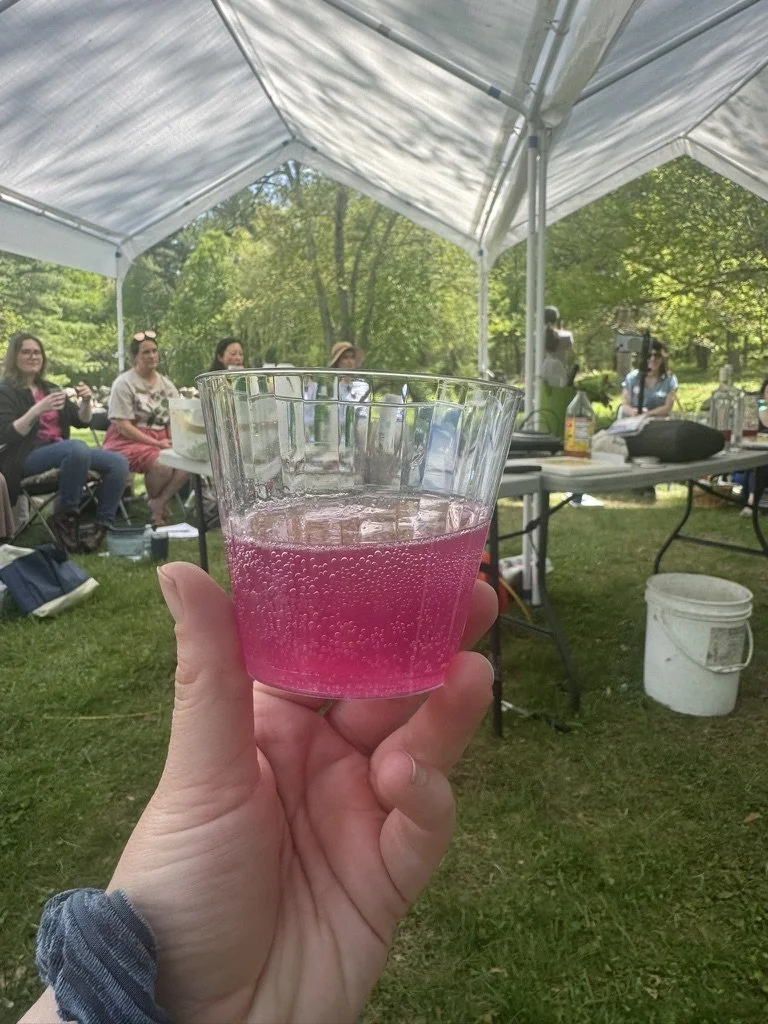
The weekend closed with violet alchemy. We added lemon to a violet simple syrup and the deep purple turned electric pink before our eyes. Mixed with sparkling water, it was stunning and delicious. Violet is a gentle but purposeful plant: it soothes respiratory tissues, calms dry skin, and quietly supports the lymphatic system. It is also, in the language of flower essences, a heart medicine. Sweet, calming, a little luminous. We held our glasses up, that bright pink catching the afternoon light, and it felt like exactly the right way to close a weekend that had been, from the first foraged leaf to the last sip, about nourishment in every sense of the word.
This is what seeds do when you plant them in good soil. They take hold.
If this resonates with you, the Boston School of Herbal Studies offers a range of programs for anyone ready to deepen their relationship with plants, whether you are just getting acquainted with your green neighbors or have been working with herbs for years. Explore our offerings at bostonherbalstudies.com/education.
