
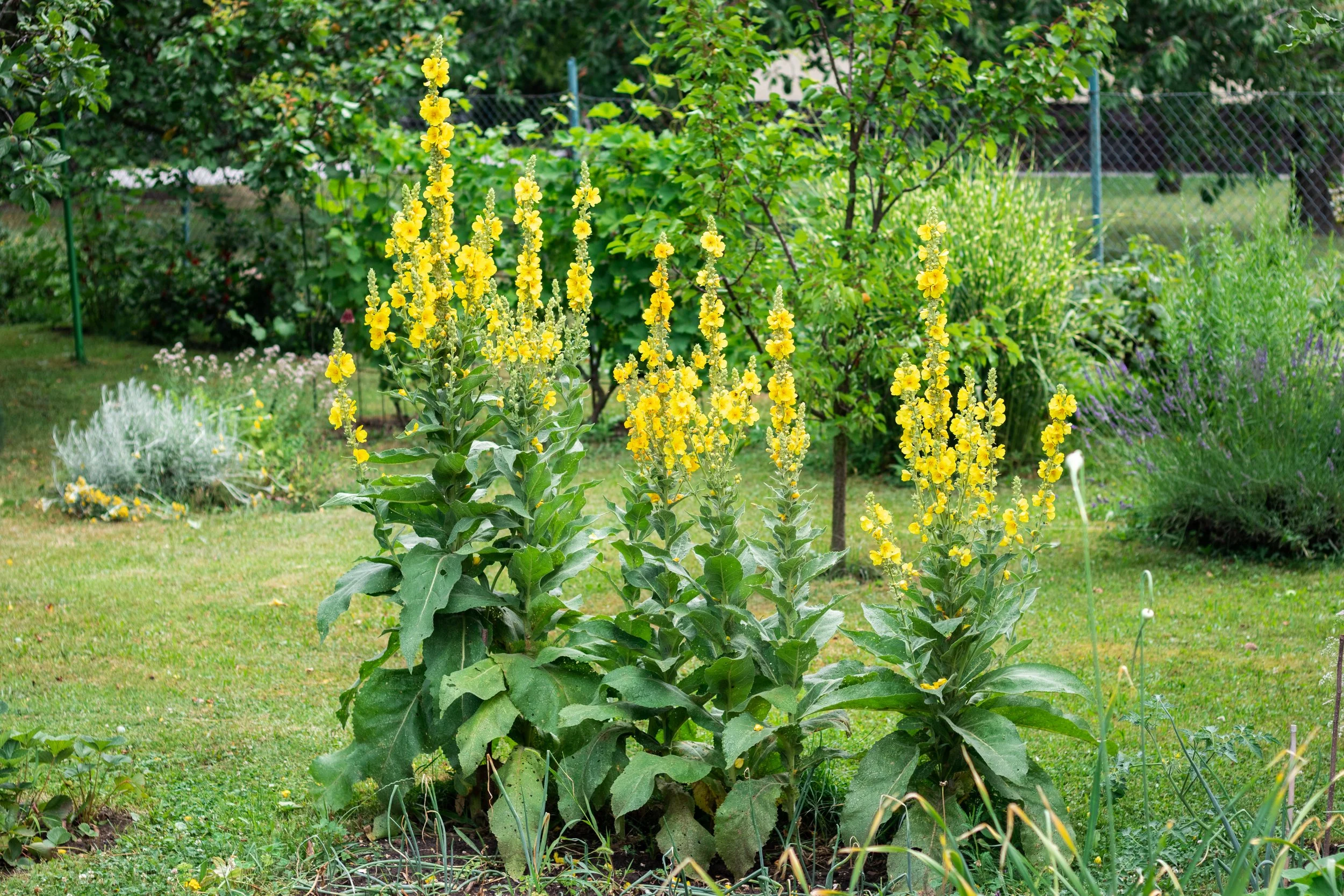
When fall arrives, mullein is one of the herbs I seek. It is a tall velvet-leaved biennial with small yellow flowers growing around a stalk. Both the leaves and the flowers are used medicinally.
Mullein is demulcent, emollient, astringent, expectorant, sedative, and a nonnarcotic pain reliever.
As a premier lung tonic, mullein works wonderfully well for harsh, dry coughs, hoarseness, sinus congestion and bronchitis. As a soothing expectorant, mullein helps to thin the mucus so that it can more easily be expelled.
Mullein leaves are smoked to relieve irritating coughs and to help withdraw from the use of tobacco. Mullein helps the lungs recover from smoke inhalation.It also has a cleansing action on the lymphatic system.
The leaves mashed in apple cider vinegar can be applied topically for swollen glands.
I have frequently wrapped mullein leaves around sprained ankles and wrists to accelerate healing. Mullein has the ability to align the connective tissue so that function is quickly restored.
Mullein flowers are also used for ringworm and other skin infections. Mullein flowers infused in oil have analgesic (pain reducing) properties and are used for earaches and eczema of the outer ear as well as headaches and nerve pain.
As a soothing diuretic, mullein leaves are useful for urinary tract infections and fluid retention.
The relaxing and pain reducing qualities of the flowers help to encourage restful sleep and release from tension.
A compress or poultice of the leaves can be applied topically to aching muscles, burns, sores, and ulcers.
In ancient times, mullein was known as a protective herb.It was grown in monastery gardens in the middle ages for its healing actions and to guard against evil. Finally, mullein was carried as a talisman of safety.
As a flower essence, mullein helps us to be true to ourselves and is especially useful when we are indecisive.
Blessings,
Madelon Hope